WHAT IS A WATER COOLING TOWER?
WHAT IS IT USED FOR?
A water cooling tower is a heat removal unit that cools hot water from the system by evaporating a portion of it into the atmosphere and collecting the remaining portion, once it reaches the required temperature, in a tank below for use in the facility.
Water cooling towers are used in industrial facilities and HVAC systems across all sectors to obtain cooled water.
TYPES OF WATER COOLING TOWERS
A. Types of Water Cooling Towers According to Their Working Principles
Counterflow towers
Crossflow towers
1. Counterflow Towers
In counterflow water cooling towers, water flows from top to bottom over the fillings while air moves from bottom to top. These are the most preferred towers today.
There are two types:
Induced draft towers: The fans are located at the top. Cooling is achieved by drawing air upwards through the side air louvers with the help of a fan at the top.
Forced-draft towers: The fans are on the sides, and cooling is achieved by pushing air upwards from below with the help of the fans.
2. Cross-Flow Towers:
In cross-flow water cooling towers, the airflow is horizontal or diagonal as the water flows from top to bottom over the packing. Cross-flow towers have forced-draft and forced-operation types.
B. Tower Types According to Cooling Type
1. Open-Loop Water Cooling Towers
In open-loop systems, cooling water is sprayed directly onto the packing inside the tower. Efficiency is higher in this type of tower, but contamination of the water is possible as the water is in contact with the environment.
Click here for the working principle of an open-type cooling tower>>>
2. Closed-Loop Water Cooling Towers
In closed-type towers, the cooling water circulates within metal coils (heat exchangers) inside the tower. The water inside the heat exchanger is cooled indirectly from the outside of the pipes by cold air and the tower's circulating water. In this type of tower, the cooling water always remains clean because it does not come into contact with the environment. Indirect cooling reduces tower efficiency.
Click here for the working principle of a closed-type cooling tower>>>
WHERE ARE WATER COOLING TOWERS USED?
Water cooling towers are used to cool water in every sector where hot water is generated. For example:
As seen above, water cooling towers can be used in many sectors.
HOW DO COOLING TOWERS WORK?
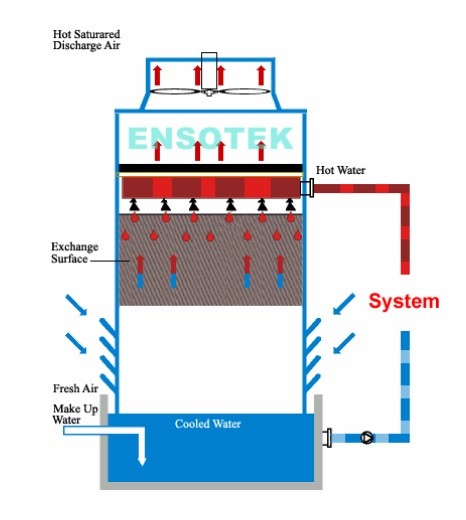
In counter-flow forced-draft type water cooling towers, the water heated from the facility is sprayed homogeneously from top to bottom across the entire cross-section of the tower with the help of a specially manufactured water distribution system and nozzles. The sprayed water masses are broken down by filtering through the tower fills. Air with the humidity of the outside environment is drawn from bottom to top over the fills with the help of the motor and fan group located at the top. The water, which meets the air on the filling cooling surface, cools by giving heat to the air and a small part evaporates. The cooled water is collected in the cooling tower's cold water pool. The collected water is sent to the facility with the help of a pump. Air, whose humidity has increased due to the evaporation of water (near the saturation point), is expelled into the atmosphere through the fan chimney at the top of the tower. This operation is shown in the attached image.
In these towers, which we call wet-type towers, a portion of the water evaporates during cooling.
Evaporation Loss
According to thermodynamic principles, approximately 540 calories of energy are absorbed from the system for each gram of water that evaporates to undergo a phase change.
With this approach, for every 6ºC cooling of the water circulating in the system, approximately 0.9% of the circulating water flow must evaporate; this is called the evaporation loss of a water cooling tower.
This amount can be calculated using the following formula:
Evaporation Rate (m³/h) = 0.00085 x 1.8 x Flow Rate (m³/h) x (Tg—Tç)
For example;
In a cooling tower that cools 100 m³ of water per hour from 40ºC to 30ºC, the evaporation loss is as follows:
Evaporation Rate (m³/h) = 0.00085 x 1.8 x 100 x 10 = 1.53 m³/h
In cooling towers, besides evaporation loss, there is also drag loss and blowdown loss. In a properly designed cooling tower, drag loss is negligible.